How to Host a Game Night at Home: Games, Food, Drinks, and Setup
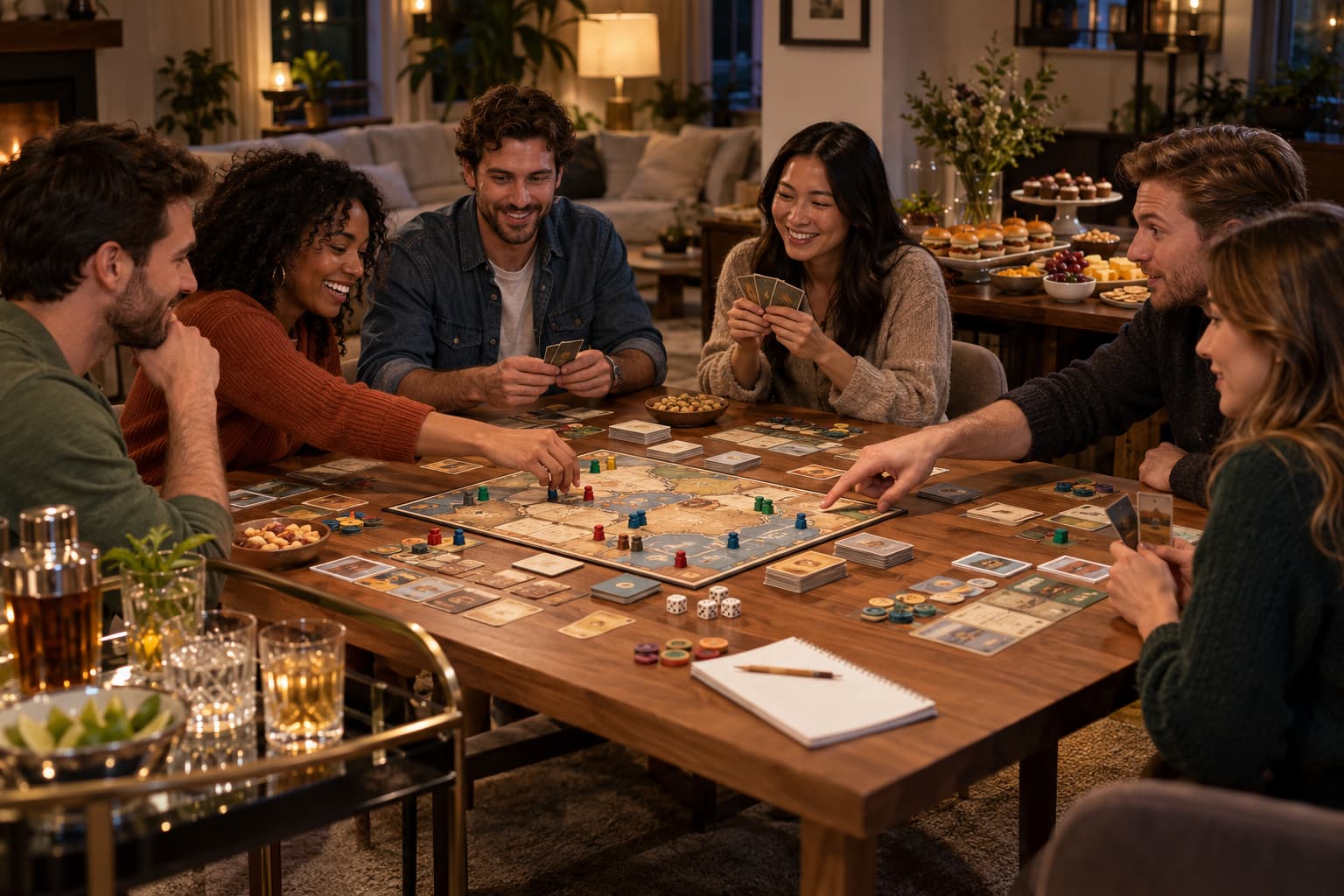
Good game night ideas solve four practical problems before the first guest arrives: who can comfortably play together, which games fit the group, what food will survive beside cards and controllers, and where everything should go. For most homes, 4–8 guests and a three- to four-hour program provide enough variety without making the evening difficult to manage.
| Plan | Recommended starting point |
|---|---|
| Guests | 4–8 people |
| Duration | 3–4 hours |
| Games | One short opener, one main game and one backup |
| Food | 6–8 small bites per person after dinner; 10–14 if snacks replace dinner |
| Drinks | Water, two nonalcoholic choices and a short alcoholic selection |
| Setup | Main game table plus separate food and drink stations |
| Preparation | Finish cooking and set up the first game before guests arrive |
Start with the Guest List and Schedule
Four to eight people can usually share one table, see the same board and remain part of one conversation. For a larger game night party, choose a team format or prepare two simultaneous tables. Adding extra chairs does not solve a mismatch between ten guests and a game designed for six.
Decide whether people should eat before they arrive. If the invitation promises snacks but the evening overlaps dinner, guests may expect something more substantial than bowls of pretzels. State the start time, likely finish time and food plan clearly.
A three- to four-hour game night at home allows for arrivals, explanations, a main game and at least one change of pace. Avoid filling every minute in advance. The schedule should prevent dead time, not interrupt a game everyone wants to continue.
Prepare Three Types of Game
Each selection should have a distinct purpose:
- Opening game: 10–30 minutes, simple rules and short rounds.
- Main game: 45–90 minutes, matched to the confirmed number of players.
- Backup game: quick to launch if the main choice finishes early or falls flat.
Use the player count and playing time stated by the publisher, then allow additional time when most guests are learning. A game listed at 60 minutes can occupy considerably longer once setup, rules and first-turn questions are included.
The opener should tolerate interruptions. Trivia, drawing, word games and short card rounds allow late arrivals to join without restarting the entire session.
Choose Games That Fit the Group
Choose for the people in the room, not for the reputation of the game.
| Group or situation | Suitable format |
|---|---|
| Guests do not know one another well | Quick party, word or drawing game |
| Competitive group | Cards, strategy or a short tournament |
| Mixed experience levels | Team game with simple decisions |
| More than eight players | Team play or two parallel tables |
| Guests arrive at different times | Short rounds with easy entry |
| Energy drops late in the evening | Fast digital or reaction-based game |
For an adult game night, clarity matters more than complexity. An experienced group may enjoy a detailed strategy game, while a mixed company generally needs rules that can be explained within a few minutes. Strong game night ideas for adults also leave room for conversation instead of demanding constant concentration from every participant.
Do not build the evening around one title. Someone may dislike bluffing, the final headcount may change, or the main game may finish much earlier than expected. Two genuinely different alternatives give the host somewhere useful to go.
Know When to Change the Game
A planned game does not deserve unlimited time. Finish the current round and switch when several players repeatedly reach for their phones, side conversations replace attention, or the same person controls every decision.
Continue when players ask for another round, discuss previous moves or immediately reset the pieces themselves. The printed schedule matters less than the response around the table.
If the problem is pace, choose a shorter game. If it is complexity, switch to teams or use something with fewer rules. If several guests want different things, divide the room into two groups rather than forcing a unanimous choice.
Set Up the Room for Easy Play
The playing surface should hold the board, cards, components and each person’s hand without competing with dinner plates. Clear it completely before arranging the first game.
Divide the room into practical zones:
- the main table for games;
- a side table or kitchen counter for food;
- a stable surface for bottles, pitchers and ice;
- a small station for plates, napkins and waste.
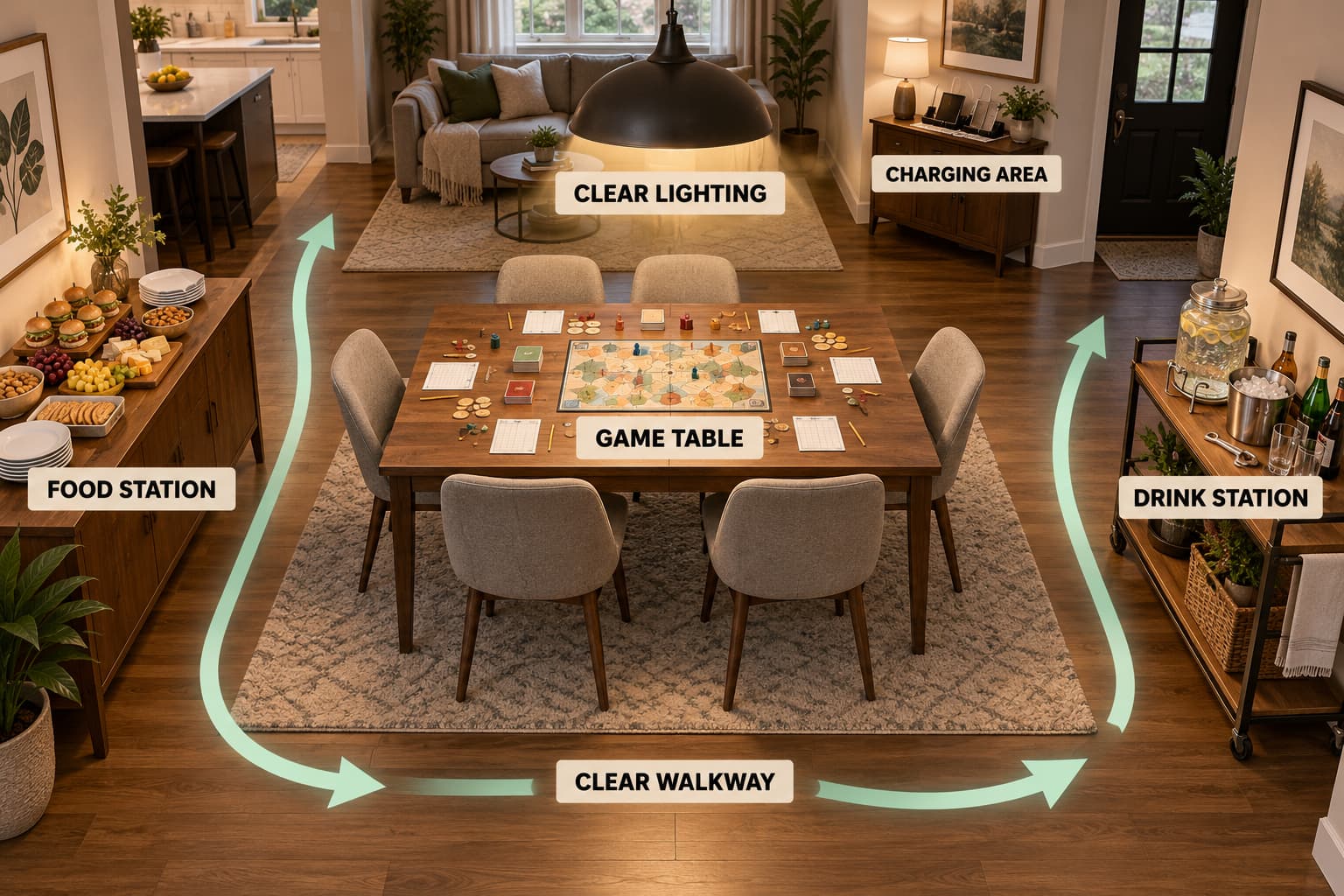
Every participant needs a proper seat and enough light to read cards without lifting them toward a lamp. Position chargers and extension cords where they cannot cross a walkway.
Music should fill pauses rather than compete with rules and conversation. Start at a low volume and keep the speaker away from the person teaching the game.
Arrange the Game Table
Set up the opener before anyone arrives. Sort the cards, tokens, pencils and score sheets, then open the instructions to the setup or first-turn section. Guests can begin playing instead of watching the host separate components.
Leave the center clear for shared pieces and give each player room for a hand of cards or personal board. Keep pitchers and large bottles elsewhere. If drinks stay beside individual seats, use stable glasses and coasters outside the main playing area.
Settle any house rules before the first round. Changing the scoring method halfway through a close game creates more argument than the original rule ever would.
Game Night Food Ideas
Food should be easy to portion, simple to replenish and possible to eat without leaving the game for half an hour. Quantity depends on whether the snacks follow dinner or replace it.
| Party format | Working quantity |
|---|---|
| Snacks served after dinner | 6–8 small pieces per person |
| Snacks replacing dinner | 10–14 pieces per person, including filling items |
| Dry snacks | About 1 oz / 28 g per person |
| Small desserts | 1–2 pieces per person |
These figures are a household planning range, not fixed serving sizes. Pieces vary enormously: one slider is more substantial than one grape skewer. University event-planning guidance ranges from 6–8 appetizers for a late reception to considerably more when appetizers replace a meal, which makes the menu composition as important as the raw count.
A useful spread needs only four components:
- one filling savory item;
- one fresh or lighter option;
- one dry snack;
- one small dessert.
Add an alternative that covers the dietary needs already identified within the group. Prepare as much as possible before the doorbell rings. A host still frying, slicing and washing pans cannot teach the opener or introduce guests.
Choose Low-Mess Game Night Snacks
The best game night snacks can be picked up with one hand and eaten in one or two bites. Suitable choices include:
- mini sandwiches or sliders with contained fillings;
- cheese, crackers and grapes;
- skewers or pinwheels;
- vegetables with dip in individual cups;
- popcorn, pretzels, nuts or dry snack mixes;
- brownies, firm cookies and bite-size desserts.
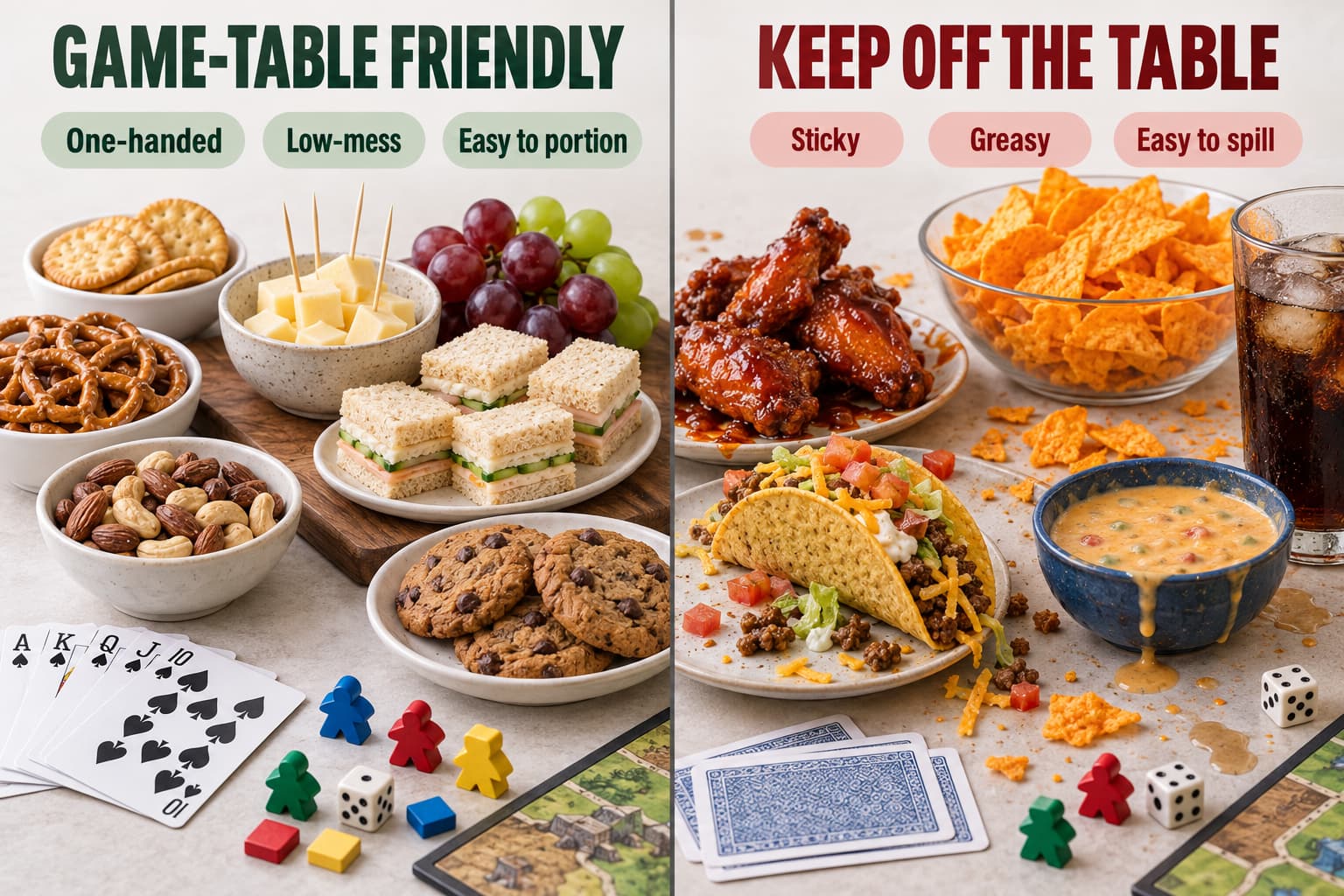
Avoid sticky glazes, greasy wings, powdered coatings and loose fillings. Overloaded tacos, saucy noodles and anything requiring a knife are better served during a defined meal break, before the board returns to the table.
Keep dips, olives and other wet foods at the snack station. Small plates are useful even for finger food because they stop crumbs and used cocktail sticks from migrating toward the game.
Keep Party Food at the Right Temperature
Perishable food should not remain at room temperature for more than two hours, or more than one hour when the surrounding temperature exceeds 90°F / 32°C. Cold food should be held at 40°F / 4°C or below and hot food at 140°F / 60°C or above. These limits follow USDA food-safety guidance.
Serve cold dishes in smaller batches and replenish them from the refrigerator. A slow cooker or warming tray can hold food that has already been fully cooked and heated; it should not be used to bring a cold dish gradually to serving temperature.
Drinks for Game Night
A practical drink station needs cold water, two nonalcoholic choices and a concise alcoholic selection such as beer, wine or one pre-mixed cocktail. More options create extra bottles and work without improving the evening.
Before guests arrive:
- chill bottles and cans;
- fill a water pitcher;
- place ice and glasses together;
- provide a bottle opener;
- label similar-looking pitchers;
- keep a cloth or napkins beside the ice bucket.
For supply calculations, one US standard drink contains about 14 grams of pure alcohol: approximately 12 fl oz of 5% beer, 5 fl oz of 12% wine or 1.5 fl oz of 40% spirits. Container size and alcohol strength vary, so one can or cocktail does not always equal one standard measure. These values follow National Institute on Alcohol Abuse and Alcoholism guidance.
Large bottles, open cans and pitchers belong on the drinks station. Individual glasses can remain beside players as long as they do not occupy the board or card area.
A Simple Game Night Timeline
Use the schedule as a framework rather than an announcement.
| Time | Activity |
|---|---|
| 0:00–0:30 | Arrivals, drinks and opening game |
| 0:30–1:45 | Main game |
| 1:45–2:05 | Food break and table reset |
| 2:05–3:00 | Second game or digital round |
| After 3:00 | Short final game or open play |
If the main game runs longer and everyone remains engaged, let it continue. If attention disappears after 40 minutes, finishing early is better than defending the original plan.
Serve the most substantial food before the main game or during the scheduled break. Repeated kitchen trips interrupt turns and fragment the group.
Final 30-Minute Setup Checklist
Before the first guest arrives:
- set out the opening game;
- confirm that every seat has enough space;
- move food and drinks off the playing table;
- put out the first batch of snacks;
- prepare plates, napkins, coasters and bottle openers;
- open the rules to the setup page;
- place pencils, paper and a timer within reach;
- charge phones and other digital devices;
- turn on the main table lighting;
- start the playlist at a low volume;
- keep the backup game nearby.
A successful game night at home does not depend on an enormous collection or an elaborate menu. Match the games to the group, change pace before attention disappears, keep food away from the components and finish the setup before the first knock at the door.